
The ADHD Reset Menu
What to Do When Your Brain Hits Overload

TL;DR Overload is a signal, not a failure; catch it, reset, and let good-enough be enough.
I’m sitting here on Tuesday of a three day week.
With a lovely little getaway planned - for which I am eternally grateful. And I’m stressed. I have to fit three days of coaching into two and two days of office work into one. I have an article due to my Substack that I have not pre-written and many responsibilities to take care of for my multiple jobs. I’m trying to plan for a few huge, looming shifts in my business, the business I run with my husband, and my family. And I’m frozen.
I can feel it in my body. The back of my neck is a little tingly. My shoulders are so tight that my arms feel tired. And my breath is more shallow than usual. I can’t sit still. Every five minutes I need to get up for something. A drink of water. Oh, I gotta pee. My dog needs something. Ugh, I want a snack.
I can feel it in my brain. My brain is playing loud earworms on repeat. All of the tasks on my plate are circling around screaming for attention. Even my tinnitus is either louder or harder to ignore.
I can’t figure out what to prioritize. My desk is so messy that I can’t even put my water down on it. And I have more than 100 tabs open across several browsers.
I’ve got Claude.ai plotting out how I should deal with my next month and I’m trying to revise my Notion so it can actually help me with task management. I have an in-person client coming in an hour. Another session after that, and I need to cook dinner and get ready for our trip.
What should I do now?
Put my head down and power through? That was my first inclination. Hide the crap on my desk in my closet (where it will never be seen again), and just keep working, pushing, trying harder.
Wait a sec. I’ve gotta stop. What did I just notice? Did I catch a story? “She’s so smart, she could get her work done if she just tried harder.” Aha! Gotcha! That story doesn’t serve me and I’m realizing that pushing through all of this right now is not going to work.
Now that I’ve noticed that…really, as soon as I’ve noticed that, I can feel myself backing up a little. If I keep pushing forward, I’ll end up an angry ball of nerves. I won’t be an effective coach or a connected family member. And I probably won’t even get much more done.
Now that I’ve noticed, I get to ask myself: what’s helped me in the past?
I need a quick break. Maybe a little somatic wiggle. I’m gonna try that and come back.
Ok. Did it! Instead of a “Elmo’s World” bashing through my head, I have John Coltrane’s “Say It,” floating through instead. That’s a HUGE improvement!
No more songs bashing and I can actually think straight for a second. Quick reset #1 found: move my body, even just a little, bonus if I make it joyful.
But I’m still scrambling and my thoughts are still swirling. What else helps? I know that I don’t want my client to see my office like this. Cleaning up will actually take care of three things: 1. My office will feel cleaner and I won’t feel so cramped. 2. I will have a clean office for my client in an hour. And 3. It will get my body moving even more.
I still really don’t want to do it. But I know that motivation does not beget action, action begets motivation. So I’m going to start. I think 5 minutes will be enough to tidy for my client. Let’s see where that gets me. Turning on some music and setting a timer now.
I’m back. Turns out the office took me 20 minutes, and then I picked up the front room for another 10. So 30 minutes of music, moving my body, and picking up. Things are feeling better. I’m really glad I noticed that I had the time to do this.
I can now move at my desk and roll my chair around without running into crap on the floor. I’m no longer worried about appearing unprofessional in front of my client. Oh! And I’ve opened the window to my office. Fresh air always helps me breathe a little deeper and feel a little clearer.
I now have my client in 15 minutes and I feel more ready to be present for him. I feel proud of my office space again. And I’ve just got time for a little transition ritual (I forget to do those when I let myself stay in too much overwhelm).
What are transition rituals, you ask?
Transition is tough on our ADHD brains - switching tasks takes a lot of executive function, and we can get frozen in the gap between one thing and the next. When that happens, we don’t need a push, we need a bridge. Transition rituals help us build that bridge.
Some transition rituals that help me:
Get my toes in the dirt, or at least get outside and breathe some fresh air
Do a fun somatic wiggle or dance to a song
Do a quick thing that makes my space feel refreshed — wipe off my desk, put something away, switch my lighting around, open my window
Light a candle and/or burn some incense and/or spray some room spray
Do a little balancing, stretching, or combine them with a little yoga
Get up and walk to another room. Maybe refresh my tea or water.
Some of these things take a few minutes, some a few seconds. It all depends on what feels right to you in the moment. What transition rituals might work for you?
Back to the task at hand.
I enjoyed a transition ritual/reset of refreshing my tea, and was able to be present for two really productive sessions despite my insurmountable mountain of tasks.
One of the biggest shifts in this day was to accept that I couldn’t just push through — not without causing damage (i.e. not being present or increasing my stress).
So I finished my day without perfection. I have a goal of getting outside every day (this does a lot to assist my nervous system). I never did get outside. I didn’t even come close to finishing my list. And I accepted that. I also celebrated that I recognized when I needed to be done, switched gears, and ended the day with dinner and some enjoyable family time.
I’m not alone.
Many of us ADHDers spend much of their time in some sort of nervous system overload.
You may have heard me say that ADHD is in no way a deficit of attention. Our challenge is a lack of filters that allow others to focus their attention. What we end up with is so much input (because it’s not filtered) that we can’t process it all. We end up in information overload. Our sensory experience becomes louder. Our ability to prioritize diminishes. And our capacity to regulate our emotions falls away. Add to all of this the constant strain of executive function in a world that expects our brains to function differently.
And how does this look different from normal, healthy stress? Healthy stress helps us function and move through our day. Overwhelm gets in the way.
How do we tell when we’re reaching a heightened state of overwhelm?
This can be tough, as we often find it difficult to notice both emotional and physical cues. Add to that the sneaky fact that overwhelm can look different from person to person and day to day. It’s really hard for many ADHDers to catch it.
The Signs
Internal and emotional clues:
Tight muscles, especially neck, shoulders, and chest
Brain fog
Restlessness
Agitation and snappiness
Emotional outbursts
Urge to escape
Reduced frustration tolerance
External cues:
Productive procrastination
All-out freeze mode, unable to get anything done
Escaping with less healthy habits: doom scrolling, binge watching, binge eating, substance misuse, etc.
Needing silence, darkness, wanting to retreat into some sort of cave
Forgetting more than usual (now that’s a feat!)
The Triggers
What can make it worse? Too many competing priorities, too much sensory input (bright lights, loud noise, uncomfortable clothes, people talking at you or being loud around you), too much time inside, the wrong music, too much clutter around, too much screen time, multitasking, deadlines, hunger, not enough exercise, sitting too much, decision fatigue, too many transitions, deadlines, etc, etc…
What Helps
First, you’ve got to catch it: your brain starts repeating that things are too much, or you start behaving like a ping pong ball on acid, or you find yourself snapping at innocent interactions or crying at the slightest thing, or you have songs bashing through your skull, or you just feel really stressed out. Once you’ve caught it, pause for a second. Ground by taking a breath or pressing your toes to the ground, or feeling the tips of your fingers.
Then: try to take the opposite action of what’s triggering you. If things are too bright and loud, find a quiet, dark space to sit in. If priorities are swirling, choose one and put the rest away. If your clothes are uncomfortable, change them. If you didn’t get enough sleep, take a nap. If you are hungry, eat a healthy snack - protein preferred.
Then go a little deeper: breathe a few more times, drink some water, eat a little more food (preferably protein), lower the noise, dim the lights, silence notifications, leave the room, reduce demand - stop trying to fix everything. When you’re ready, pick one thing, preferably something you can finish. And do that. And celebrate the completion!
Pause all nonessential tasks. Ask - is it a survival task or is it taking care of an annoyance? Or as Ellen Langer says: a tragedy or an inconvenience? And it helps to find a mantra that reduces your shame in times like this: I’m overloaded, not broken. I’m doing the best I can as I continue to build environments that work for my brain.
The Resets
All of the transition rituals above act as quick resets.
Resets that take a few minutes:
The 2-minute reset: bathroom break, water, three slow exhales, then one tiny decision.
The sensory reset: headphones, sunglasses, a blanket, a hood, or stepping outside.
The nervous system reset: hand on chest, feet on floor, longer exhales, or a short walk.
The attention reset: close extra tabs, put the phone away, and return to one task only.
Resets that take 10–30 minutes:
A quiet reset block with no talking, no screens, and no decisions.
A snack-and-sit reset for blood sugar, hydration, and nervous system recovery.
A movement reset: stretching, pacing, a walk, or shaking out tension.
A “blank space” reset: lie down, stare at the ceiling, or sit in silence until the system settles.
Resets that require more time:
A half-day reset: cancel nonessential plans, reduce social demands, and protect quiet.
A full-day regroup: sleep, eat, move gently, and avoid overcommitting.
A weekend reset: fewer inputs, no pressure to catch up on everything, and structured rest.
A vacation or leave-from-work reset when the pattern has become chronic burnout rather than a one-off overload.
What Not to Do
Don’t force it. As soon as it is safe to step away and make a change, do it.
Don’t shame yourself for needing rest.
Don’t “just try harder.” It hurts more than it helps.
Don’t confuse the need for a shift, or rest, with avoidance.
Remember
It’s ok to seek help when you need it. Reach out to a clinician, coach, therapist, or medical professional if you’re experiencing persistent shutdown, burnout, panic, depression, an inability to function, or overwhelm that becomes persistent or disabling. And don’t forget that trauma history, co-occurring anxiety, and chronic stress can intensify our experiences of overwhelm.
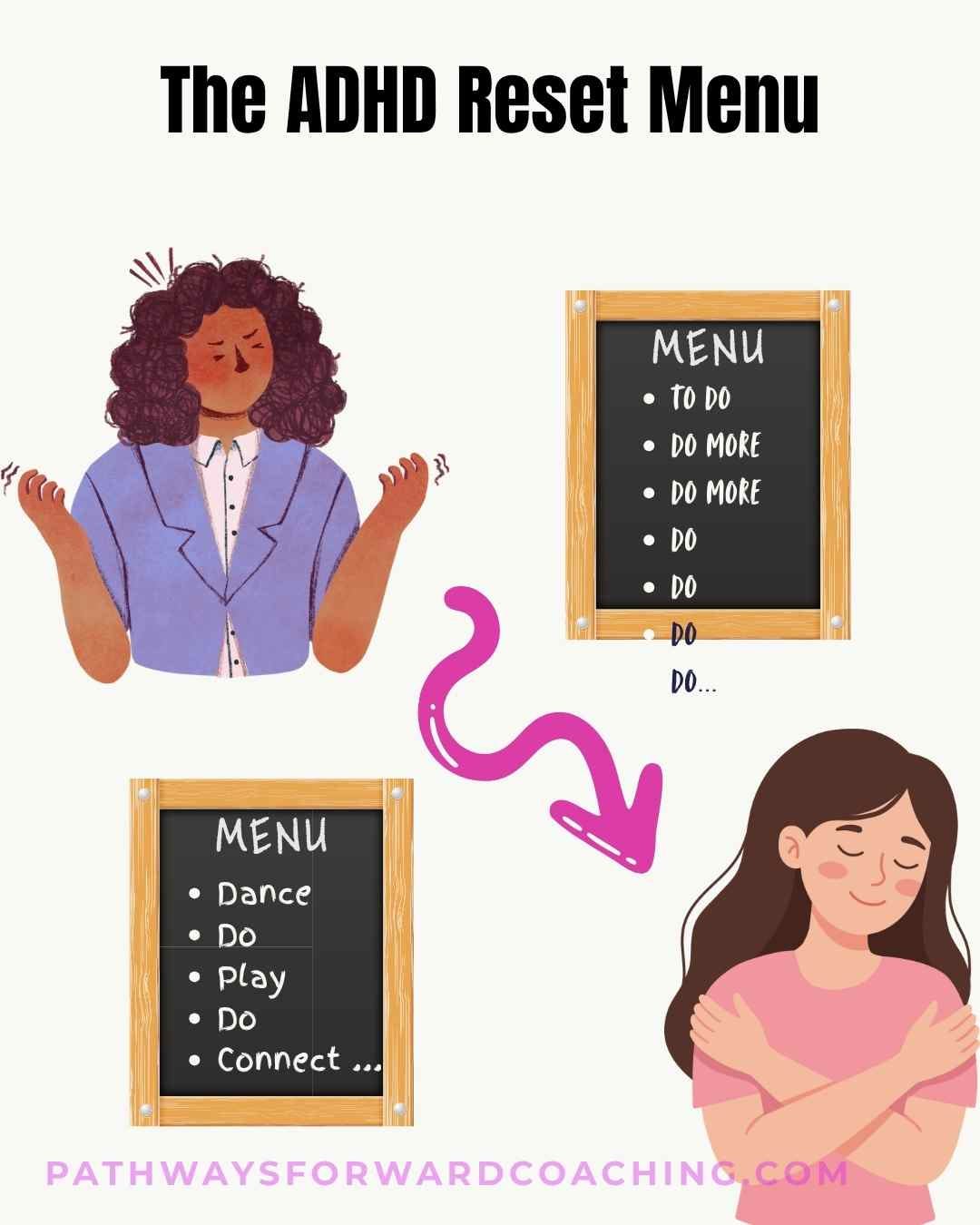
Make Your Menu
Overload is a signal, not a character flaw - the same way a wilting plant isn’t failing, it’s telling you something about the soil.
What would be on your personal reset menu? What are your signals? What helps? Write the lists, and keep them somewhere you can find them when things start to be a little too much.