
ADHD Unseen:
She Wasn’t Broken. She had ADHD and No One Had Seen It.

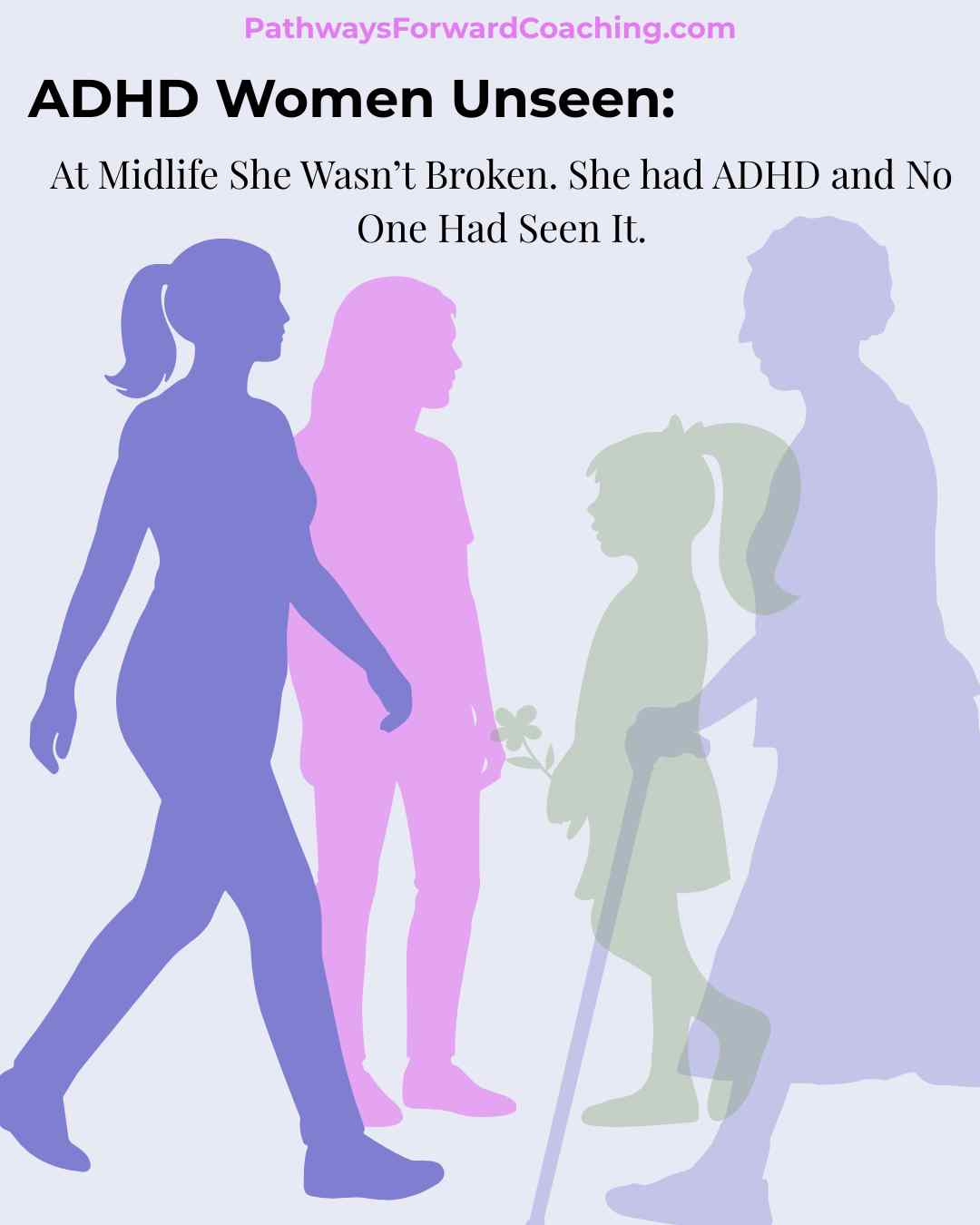
Recognize Her?
She’s 45 years old, and she cannot figure out why her life is unraveling.
For decades she has done everything right. She built the career. She raised the kids. She ran the household, managed the calendar, remembered everyone’s birthday, packed the lunches, hit the deadlines, and still somehow showed up with a smile. From the outside, her life looked like a Pinterest board. From the inside, it felt like running a marathon in concrete shoes.
But now the cracks are showing, and she’s out of spackle. Because here’s the thing about a lifetime of white-knuckling it - the bill always comes due. Every year of overcompensating, over-preparing, and over-performing has been making unlimited withdrawals from a finite account. The burnout isn’t new. It’s been building quietly for decades, and now it has finally arrived.
She’s losing her temper with the people she loves most. She’s missing meetings. Forgetting deadlines. Making the kind of small mistakes that have large consequences. Her friends are frustrated. Her marriage is strained. Her teenagers are letting her have it. And every night she lies in bed with her brain running a highlight reel of every misstep, every forgotten thing, every dropped ball — while the to-do list for tomorrow is already forming.
She is her own harshest critic. She compares herself to the put-together women on social media and wonders what is wrong with her. Why can’t she just do better? And she’s not the only one asking - her boss, her husband, her kids, her friends, they’ve all got opinions about how she should be doing more, trying harder, talking less.
Her anxiety is through the roof. Her depression is real. She can’t sleep, and yet she wants to sleep all the time. Her brain is in a fog so thick she can barely see through it. She’s forgetting things she knows she knows. She starts wondering: is she losing her mind? Is this early dementia? What is happening to her?
Here’s what’s happening: her brain has been screaming ADHD for decades. And nobody listened.
How Did She Get Here?
This is the third installment in a series on ADHD diagnosis in women across the lifespan. Two weeks ago, the focus was on girls. Last week, teens and young adults. And now here we are at mid-life - where the wheels really start coming off.
As a woman moves into her 40s and 50s, everything hits hard. The hormonal shifts of perimenopause are throwing fuel on a fire that’s been quietly burning her whole life - estrogen and progesterone, the very hormones that help buffer her dopamine system, begin to drop, and suddenly the brain fog is worse, the forgetfulness is worse, the emotional dysregulation is worse. But the hormones are only part of the story. Layered underneath is something that’s been building for decades: the accumulated weight of chronic stress, of running on empty, of a nervous system that has been in overdrive since childhood without anyone ever once asking why. The burnout isn’t new - it’s the inevitable end point of a lifetime spent white-knuckling through a world that was never designed for her brain. And every coping strategy she’s spent a lifetime perfecting - the late nights, the color-coded everything, the caffeine, the adrenaline, the sheer brute-force willpower - stops working. Not because she’s gotten weaker. Because the account has finally hit zero.
At the same time, she is likely running a household, managing a career, raising teenagers, supporting aging parents, holding relationships together, and still being told she’s “just stressed.” Or “just hormonal.” Or “just not managing her time well enough.”
Just - As if her entire nervous system isn’t on fire.
Something eventually cracks open - and not in the way you’d expect. She sees another woman on social media telling her ADHD story. She recognizes herself so completely it takes her breath away. She thinks: wait. This isn’t a character flaw? This is a neurological thing?
Or maybe it’s her kid. Her child is struggling, finally gets evaluated, and in the appointment the clinician turns to her and asks, casually, how long she’s known about her own ADHD.
Her. Own. ADHD.
Wait, what?!?!
Why Did It Take This Long?
Let’s be very clear: this is not her fault. Not even a little bit.
Her ADHD went undiagnosed for so long because she was too good at doing what everyone expected of her. She was the responsible one, the smart one who just needed to “apply herself.” Her teachers saw potential and shrugged off her struggles. Her bosses saw results - not knowing what it cost her to produce them. Nobody said, “your brain is wired differently.” Instead, she got called lazy. Messy. Emotional. Scattered. Too sensitive. Too much.
And she swallowed it. She swallowed it and built an entire identity around compensating - perfectionism, people-pleasing, over-preparation, overthinking - not because she wanted to, but because that was what was expected of her.
She masked like an absolute professional. But let’s not put that on her. Her masking wasn’t the problem. The problem was a medical system that wasn’t looking for ADHD in girls, a school system that rewarded compliance over curiosity, and a culture that told women their struggles were personal failings rather than neurological realities. The fact that nobody connected the dots sooner is not her failure.
It is a failure of every system that was supposed to be paying attention.
The Diagnosis - and Everything That Comes With It
When she finally walks into that doctor’s office, she is done being dismissed. She is done being told it’s stress, or hormones, or anxiety, or depression — as if those aren’t also symptoms of the thing nobody’s been willing to name. She comes in with her research, her history, and her absolute refusal to leave without real answers.
And when the diagnosis finally comes, it feels like someone turned on the lights.
There is relief, yes. Real, bone-deep relief. But there is also something sharper underneath it — a righteous, burning fury. Because now she is replaying every report card that called her “unfocused.” Every performance review that said she had “potential but lacked follow-through.” Every relationship that took damage because she couldn’t explain why her brain worked the way it did. Every single time someone told her she was lazy, disorganized, or too much — when her brain was simply different, and no one told her.
She is grieving. Grieving the years she spent fighting herself instead of understanding herself. Grieving the career paths she didn’t take, the relationships that didn’t survive, the version of herself who might have existed if someone had just seen her sooner.
And she is furious. She has every right to be.
What Comes Next
Here is what else is true: she is not starting from zero. She never was.
The same brain that went undiagnosed for 40+ years is also the brain that held everything together through impossible circumstances. That hyper focused through crises, that thought sideways around problems, that felt everything deeply and cared fiercely. That was never laziness or weakness. That was her - her actual, brilliant self - surviving without a roadmap.
Now she gets to have one.
She starts learning what actually works for her brain - not the workarounds she jury-rigged in shame, but real strategies, real support, real tools. She explores medication if she wants it. She asks for accommodations without apologizing. She starts building a life that fits her, instead of contorting herself to fit a world that was never designed with her brain in mind.
She starts to put down the mask. Piece by piece. And underneath it - buried under decades of self-criticism and overcompensation - she finds herself. And she is extraordinary.
If you’re local and any of this resonates, I’d love to have you join me for Digging in the Dirt on April 11th — a workshop designed for exactly this moment. We’ll excavate what’s been buried under a lifetime of masking and self-criticism, name what’s been covering it up, and leave knowing something genuinely, beautifully true about yourself. Spots are limited.
[Register here] or reach out to Sue at sue@pathwaysforwardcoaching.com